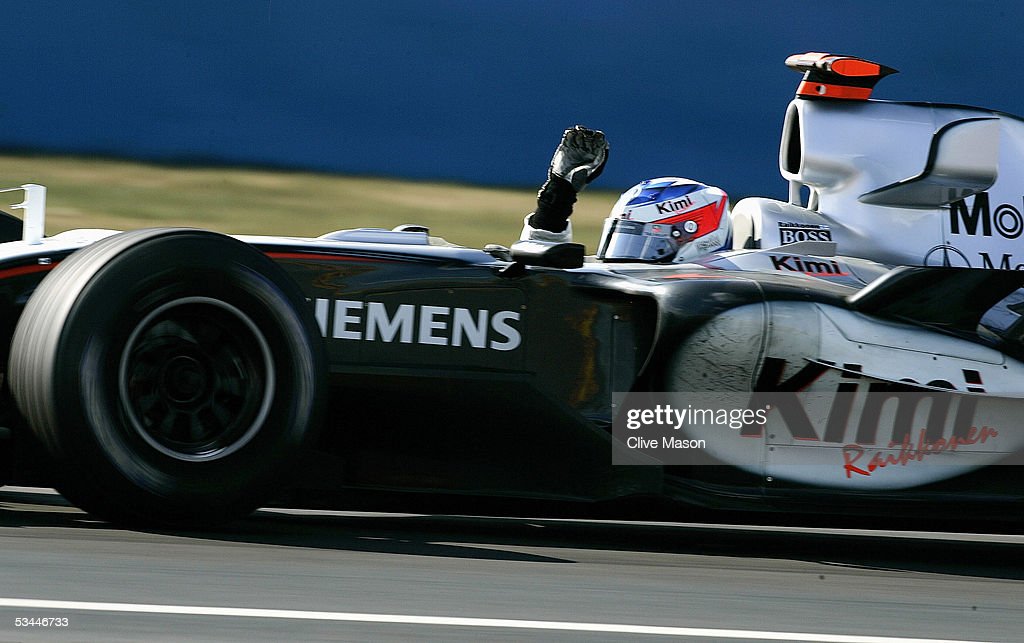
This year we said goodbye to one of the best. While he was seemingly looking forward to it, the majority of F1 fans, if not all, were sad to see him go. Lets introduce this F1 legend with the cold hard facts: He raced for five teams in his F1 career which included some of biggest names in the sport’s history. These teams were: Sauber (2001), McLaren (2002-2006), Ferrari (2007-2009 & 2014-2018), Lotus (2012-2013) and Alfa Romeo (2019-2021). He entered 353 races over 20 years, starting 349 (a record), winning 21, started on pole for 18, and finished on the podium after 103. His lone championship came in 2007, while he finished runner up twice and third 3 times with 3 of his teams. Statistically, it is one of the most note worthy careers in Formula 1 history. Culturally, Kimi Raikkonen’s is THE F1 career of modern times.
To me, he was the second in a Finnish-McLaren dynasty that started with the ‘Flying Finn’ Mika Hakkinen and ended by cementing my obsession with F1. The quiet, no nonsense and scarily quick Finns were the perfect counterpart to the organised grey machine that was Ron Dennis’ McLaren of the 1990/2000s.
Before this, Kimi burst onto the scene as a 21 year old who had only entered 23 single seater races in his junior career when Peter Sauber plugged him into his namesake team. He was instantly quick, scoring a point on his debut in Australia when points were only handed out to the top 6 places. Reports came out post-race that the young Finn could be found having a nap 30 minutes before the biggest race of his career so far and the legend of the ‘Iceman’ was born. Kimi and his teammate Nick Heidfeld lead the team to it’s best placing in the Constructors championship with 4th, both showing pace and flashes of brilliance, be it a quick qualifying lap or a brave overtake. This got them both swirled within the rumour mill for a move to McLaren with Mika Hakkinen retiring. The Mercedes backed Heidfeld was the bookie’s favourite for the drive. However, the Finnish connection paid dividends as Mika Hakkinen’s repeated recommendations convinced Ron Dennis to sign The Iceman for 2002.
I was having a shit
When asked why he missed Pele’s presentation to Michael Schumacher in Brazil, 2006.
The McLaren years of Kimi’s career are my fondest memories of him but they are also tainted with a hint of disappointment. He was instantly quick when strapped into a McLaren, scoring a podium on his first outing, but wins were hard to come by early on with Ferrari and Schumacher dominating. He came very close in France 2002 but was victim of an oil spill at the hairpin at Magny-Cours with a handful of laps to go and finished second to Schumi. His first win did come at the second race of 2003, at the Malaysian Grand Prix, in great style from 7th on the grid. He could have won the first race of the season if not for an electrical system failure which caused him to speed in the pitlane and get a drive through penalty, dropping him to 3rd. This would become a theme and it is the root of my previously mentioned disappointment. Kimi’s McLaren career was plagued by unreliability, so plagued it cost him a World Championship and basically wrote off the 2004 season. In his first three years at McLaren, Kimi didn’t have a car truly quick enough to realistically challenge for a title. This changed in 2005 when a regulations shake-up ended Ferrari’s grip on the sport so McLaren and Renault took up the fight. The McLaren in the hands of Kimi was the fastest package on the grid but too many times, while leading the race, his car let him down. He was comfortably driving away in Imola and Hockenheim when driveshaft and hydraulic failures stopped him in his tracks – I still have flashbacks to ITV coming back from an advert break to find Kimi going slowly at the top of the hill at the San Marino circuit. His other retirement from a leading position that year was suspension failure on the last lap brought on by vibrations after Kimi locked up heavily lapping Jacque Villeneuve. While you were not allowed to pit for fresh tyres during the race in 2005, they were allowed if a ‘punctured or damaged tyre’ happened for ‘clear and genuine safety reasons’. As the last lap crash which nearly took out Jenson Button’s BAR proves, this could be deemed one of those times – something later the FIA would confirm. A pitstop would have had him finish a comfortable 3rd. I am getting to my point I swear – each time Kimi retired from the lead, who was it that won the race? It was his title rival Fernando Alonso. While Kimi lost 26 point from winning positions, his title rival directly gained 6 points because of them. The final standing show that Alonso scored 133 points to Kimi’s 112. If we add 26 to Kimi’s and take 6 away from Fernando’s totals, the final standings are reversed in Kimi’s favour – 138 to 127. Job done, case closed.
Leave me alone, I know what to do!
When in the lead at Abu Dhabi 2012 and his race engineer reminds him to warm all four tyres.
2005 would be the best chance for Kimi to win a title at McLaren as in 2006 the car was quick but the old foe unreliability (and a dose of bad luck) meant the team did not record a victory in a season for the first time in at least 10 years. At the Italian Grand Prix of that year, my young self’s worst nightmares came true – my hero, Kimi Raikkonen, announced he had signed for the Empire, the Arch Nemesis, The Red Team: Scuderia Ferrari. However, it would turn out to be a career defining decision.
Kimi won his first race outing and the championship at the first time of asking with Ferrari in 2007, snatching it away from Lewis Hamilton after coming back from 17 points down with 2 races and 20 points left for the taking. This came with a sense of retribution for Kimi fans but also with a large dollop of irony as it was McLaren unreliability in Brazil that made it possible. Despite winning a title, his first Ferrari career never hit it’s potential as an inconsistent Kimi in 2008, who was beaten by his lesser teammate Felipe Massa, and a slow car in 2009 skuppering any chance of a championship run. Kimi flashed his blistering speed at times but was becoming disillusioned with the world of F1 and everything that came with the racing so decided to step away at the end of the 2009, despite having a contract with Ferrari through 2010. This was the unique quality about Kimi Raikkonen, he wanted absolutely nothing to do with the circus of F1, and he didn’t seem to have to dedicate his whole life to stay in the sport. For Kimi, F1 was the hobby that paid the bills. Although, it did help that Ferrari paid his multi-million pound wage to not drive for them in 2010, being replaced by Fernando Alonso. During his hiatus, Kimi spent his time away from the sport taking part in the Word Rally Championship and racing snowmobiles under the pseudonym James Hunt, which shows his appreciation for the history of F1 and his affinity for drivers that did it their own way.
Why not?
When asked why he was returning to Alfa Romeo Sauber for 2019.
While I am sure Kimi enjoyed his time away from the sport, the allure of F1 was too much to bare and the offer of Lotus F1 to return for 2012 convinced him to come back. One defining feature of his return was a points bonus built into his contract which essentially bankrupted the team after Kimi and the car wildly exceeded expectations over his two year stretch with the team. Lotus agreed to pay Kimi €50,000 per point he scored and he called their bluff with 390 scored over the two years. This totaled €19.5 million on top of his multi-million salary.
He took a couple of races to get going but once he did, he was consistently amongst the title fight despite Vettel dominating the second half of the season. Kimi won Lotus’ first race since Ayrton Senna took the chequered flag at the 1987 Detroit Grand Prix, at the 2012 Abu Dhabi Grand Prix which is where the infamous “Leave me alone, I know what to do” quote comes from. To be fair to Kimi, his race engineer was talking a lot. He followed that up by winning the opening race of 2013 using his car’s better tyre management to great effect and won comfortably. His consistant pace meant he was again in the title fight but only really as a distant 2nd to Sebastian Vettel. His relationship with Lotus would end unceremoniously after Lotus didn’t pay his salary for the whole season, I wonder why…? He didn’t drive the last two races of 2013, electing to have back surgery to fix an issue sustained in Singapore. This opened the door for a sensational return to Ferrari for 2014 to partner Fernando Alonso in an all-World Champion line-up.
Like his first Ferrari career, his second one did not get going as he essentially became an experienced wingman to Fernando Alonso and then Sebastian Vettel. There were a couple highlights but mainly it was a frustrating time for the team as they were outclassed by the Mercedes juggernaut. Only one pole and one win came in that time, both during 2018, in Italy and USA respectively. Towards the end of 2018, it was announced that Charles Leclerc would move from Alfa Romeo to Ferrari, which meant that Kimi had to make way for him. He would switch seats with the Monegasque driver and partner Antonio Giovinazzi for the remainder of his career. That career would come to a quiet end at Alfa Romeo as the car was not up to standards. In classic Kimi style, he quietly predicted to himself that 2021 would be his last in 2020 using F1’s YouTube channel and left without a fuss with his family in Abu Dhabi.
What made Kimi Raikkonen special was his all-time natural speed, there was no time for thought, his style was just pure instinct and reaction. He admitted himself that he didn’t have brake markers, he just braked when he felt the moment was right. What made him a fan favourite was that he was unapologetically Kimi and his rejection of the media baggage that came with the sport. Mika Hakkinen told him early on that if you don’t engage with the media they will eventually leave you alone, and Kimi happily obliged. However, this only seemed to create a cult following, keeping the media at his door. His nickname ‘The Iceman’ fitted him perfectly: a seemingly unflappable personality off track with terminator-like ruthlessness on track. At his peak, he was the quickest driver in the world but unfortunately he didn’t have a car quick or reliable enough to prove it, however when he did, he usually won.
Kimi will be sorely missed in F1 and will go down as an all-time great. So for the final time: Kimi for President!
 The Perfect Formula