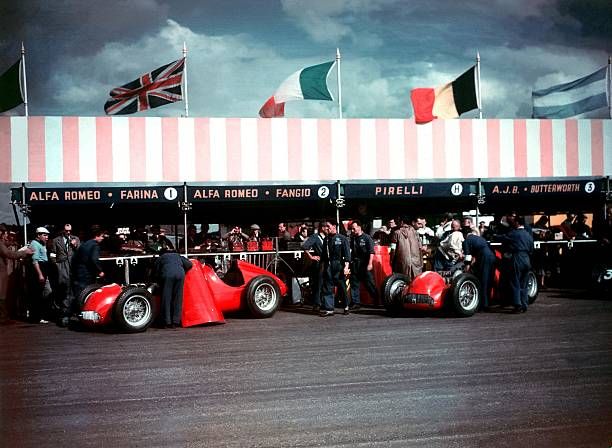
I thought I would start a series on the turning point in the history of F1, so here it is.
The first turning point in F1 history, is of course, where it started.
The Formula 1 World Championship was born on a sunny day in May 1950. The regulations had been decided 2 years earlier and a series of Formula 1 races had taken place since, but this event was the first time the drivers were competing for the title of F1 World Champion.
The World Championship was unleashed at Silverstone for the British Grand Prix, in front of 200,000 people including King George IV and his family. This former airfield had hosted a couple of British Grand Prix’s previously and already had the reputation as being one of the best tracks in the world. Confusingly, this race actually had two names, simultaneously being the European Grand Prix as well. Incredibly, the Silverstone layout hasn’t changed much since 1950 with many of the famous corners still being tackled by F1 drivers today, albeit with a few additions.
On the day, the first row was taken up by a famous Italian manufacturer, but not the one you are thinking of. Ferrari didn’t turn up to the first championship race so Alfa Romeo would take over and shine in the Northampton sun, with their supercharged 158. They would dominate qualifying and make up the first four places on the grid, with Giuseppe Farina and Luigi Fagioli making it an Italian 1-2 followed by Juan Manual Fangio and Reg Parnell.
The F1 cars of 1950 were quite different to todays, as you would imagine. For one thing, they had their engines at the front and very little aerodynamics. The heavy engine at the front and thin tyres meant they suffered from a lot of understeer – the front of the car not wanting to turn – so the fastest way around was by drifting the car around the corners. The cars were rear-wheel drive so the driver would have to floor the throttle to get the back end to step out and then would just guide the car around the corner, trying not to spin. A completely different skill set from today but no less impressive. If anything, it was more impressive because if the driver got this tricky technique wrong, they were heading towards a ditch in a highly flammable rocket.
The 24 gladiators called drivers would represent 9 nations, have an average age of 39 and even include Royalty. Prince Bira of Thailand would line up 5th in his Maserati but wouldn’t see the chequered flag, running out of fuel on Lap 49.
Once the race got going, Alfa Romeo wouldn’t let their dominance from qualifying slip. Despite Fangio retiring from the lead after 62 of the 70 laps, they would take all three steps of the podium and finish 2 laps ahead of their nearest challenger. Farina would take the chequered flag with a race time of 2 hours 13 minutes and an average speed of 143 km/h.
Reg Parnell would give the home crowd something to cheer for as he became the first Brit to win F1 World Championship points, finishing in third.
As for the rest of the field, only 11 would finish and 5 took home Championship points.
The 1950 British Grand Prix was also significant for who won the 500cc support race, a young Brit called Sterling Moss who would make his own indelible mark in the history of F1.
The Alfa Romeo’s dominance would last the whole championship, despite Ferrari getting involved at the next race at Monaco. Farina would go on to become the first-ever F1 world champion.
 The Perfect Formula