The next turning point in F1 history didn’t take place on track – not an F1 track at least.
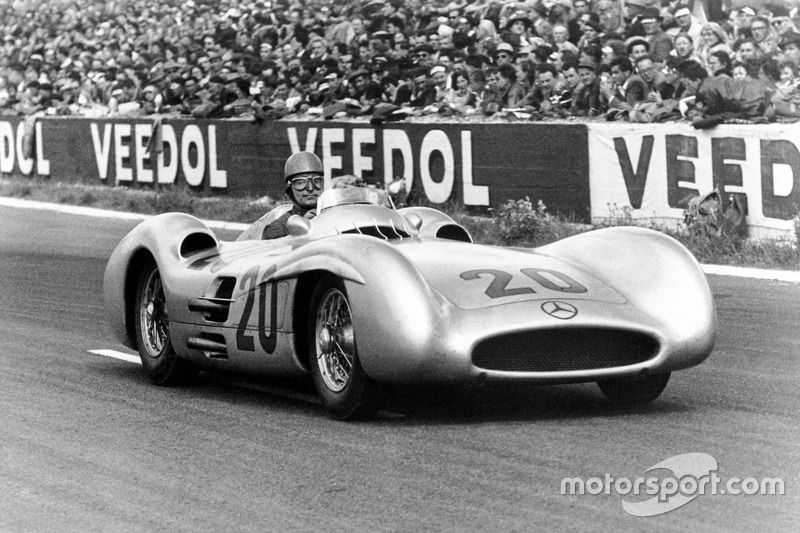
Once Alfa Romeo dominated the 1950 championship, they split the next 3 with their Italian counterparts Ferrari. However, halfway through 1954 the F1 pecking order would be ripped up with the introduction of a new Constructor – Mercedes Benz.
Mercedes entered F1 at the 1954 French Grand Prix with the iconic W196, and they would go to take a 1-2 on their debut. They even had the audacity to steal the greatest driver of the era, Juan Manuel Fangio, from Maserati mid season to lead their attack. He had already won 2 races with Maserati at the start of the season and would go on to win 4 more with Mercedes, becoming the only driver to win a World Championship with different teams in the same season. A record that will never be broken now.
But this turning point isn’t about the 1954 season, or F1 at all really, but it would change the course of the sport forever. Mercedes started the 1955 season the way they ended the ’54 season, winning 2 out of the first 4 races, with the second coming at the Belgian Grand Prix in June. However, a week later, the motorsport world would be devastated by it’s worst tragedy.
During the 1955 running of the 24 hours of Le Mans road race, Jaguar driver Mike Hawthorn pulled over to the side of the track to go into the pits, braking as he did. In doing so, he cut across Lance Macklin’s Austin-Healey who in turn swerved to avoid. Catastrophically he swerved right into the path of Pierre Levegh’s Mercedes Benz 300 SLP, who was going around 125mph. Levegh’s car launched over the back of the Austin-Healey and straight into the spectator area by the side of the track, which was only protected by a grass verge. The impact with the ground caused the car to disintegrate and explode into flames. The impact threw Levegh from the car back onto the track and killed him instantly. The debris from the exploding car would kill 83 spectators and injure 180 more.
This disaster caused Mercedes to pull out of motorsport entirely, as they were only really in it for technological testing purposes, not for the love of competition. They didn’t see the point in risking lives for the sake of progress.
Mercedes would complete the 1955 season, winning the remaining 3 races – 2 for Fangio and one for Sterling Moss (remember him?) but that would be their last season until 2010.
The Silver Arrows’ dominance of F1 ended as quickly as it started, but what a run it was. The won 10 out of the 13 races they entered to blow the competition away. Something they would continue to do when they returned to F1 – winning 8 straight Constructors Championships from 2014-2021, but more on that in a later post.
How different would the history of F1 look if they had stayed? Would they be the most successful team over Ferrari if the Le Mans Disaster never happened? All these questions we will never have answers to but I think this quote from an article in Motorsport Magazine from December 1955 gives a hint of the feeling at the time.
“The complete withdrawal by Daimler-Benz is an unhappy thing for many of us, especially those interested in technical development, but, on the other hand, they had monopolised racing to such an extent that their withdrawal will at last allow someone else to win”
 The Perfect Formula