1968 was a transition year for Formula 1 in many senses, and not always for good reason.
The Ford DFV
The year started with the wider implementation of arguably the greatest racing engine of all time – the Ford Double-Four Valve V8 – this iconic engine was conceived by Colin Chapman and Lotus F1, who had convinced Ford to develop it when 3-litre engines were introduced for 1966. It won on the first attempt at Zandvoort 1967 as Graham Hill stuck his Lotus 49 on pole, but when he retired with clutch issues, his teammate Jim Clarke came through the field to take the chequered flag in his stead.
Chapman had worked hard to get exclusivity of this engine for his Lotus team but Ford was worried their brand could be tarnished as the competition around them wasn’t strong enough; Ferrari’s engine was underpowered, the BRM was too complex, the Maserati unreliable and the Honda overweight. They wanted to instead supply to anyone who wanted one and dominate the whole of F1 rather than just one team.
They wanted to create a cheap engine – £7,500 in 1967 – competitive, light, compact and easy to run so that any team, big or small could screw it in and go racing.
So, they did. And Chapman wasn’t happy.
But Ford had made their decision and the Double-Four Valve V8 would go on to win 155 of the next 262 races from 1967 – 1985. The Ferrari was the only other engine that even made a dent. The Ford DFV would win every single race in 1969 and 1973. It became THE engine of F1 and gave Formula 1 teams the financial freedom to innovate and push the sport into the global player it is today. Without the DFV, F1 would look very different, despite Colin Chapman’s anger.
Jim Clark
While one F1 icon was just getting started, tragically the sport would lose another in 1968. Jim Clark was arguably the driver of the 1960s. Starting in 1960, he spent his whole F1 career with Lotus and won championships in ’63 & ’65 but it could have been so much more if his cars had been more reliable. Oil leaks in crucial races in 1962 & 1964 robbed Clark of two more titles but they weren’t isolated instances. There was a feeling in F1 at the time that if Clarke finished a race, he was winning it.
Clarke produced performances that even for F1, were extraordinary. In 1963, he won a rainy and foggy Belgian Grand Prix at Spa by over 5 minutes and lapped the whole field apart from Bruce McLaren in 2nd. Clarke holds the record for most grand slams in F1 history – taking pole, fastest lap, victory and leading every lap – doing it 8 times.
He would led 71.47% of the laps raced in 1963, which is another record. At the Italian Grand Prix of 1967, he started from pole and led the way until a puncture derailed his progress. He lost a lap while the wheel was changed and re-joined the race in 16th place. However, he would go on to drive back through the field, breaking the lap record on multiple occasions and even equalled his qualifying lap of 1.28.5. He regained the lap AND THE LEAD. Heading into the lap last he was narrowly leading John Surtees and Jack Brabham when his car started fluttering. It hadn’t been filled up with enough fuel. He would coast over the line in 3rd but that performance speaks for itself. He was the class of the field, even against F1 legends.
Clarke didn’t just race in F1 during his career either. He was the first non-American Indianapolis winner in 50 years when he conquered the brickyard in 1965 as the first mid-engined victor, becoming the only driver to win the F1 title and the 500 in the same year. He also raced in British saloon cars, Le Mans, American open-wheel, the Australasian Tasman series (winning it in 1965, 1967 and 1968) and F2, which would be his tragic downfall.
On 7th April 1968, Jim Clarke took part in an F2 event at Hockenheim, Germany during the 4-month gap between the first and second F1 races of the season. On the fifth lap of the race, Clarke’s Lotus veered off the track and smashed into the trees that lined the track. He suffered horrific injuries and died before he reached hospital. The exact reason for the crash has never been determined but it’s thought that it was caused by a punctured rear tyre.
His fellow drivers refused to believe that the crash was caused by driver error because they didn’t believe Clarke was capable of making a mistake like that. Clarke’s driving style was so smooth that he took care of the cars he drove – Jackie Stewart remembers “He was so smooth, he was so clean, he drove with such finesse. He never bullied a racing car, he caressed it into doing things he wanted it to do” Clarke’s tyres would last 4 races and his brake pads would last 3 times longer than other drivers. This made it even harder for people to accept that his cars didn’t take care of him.
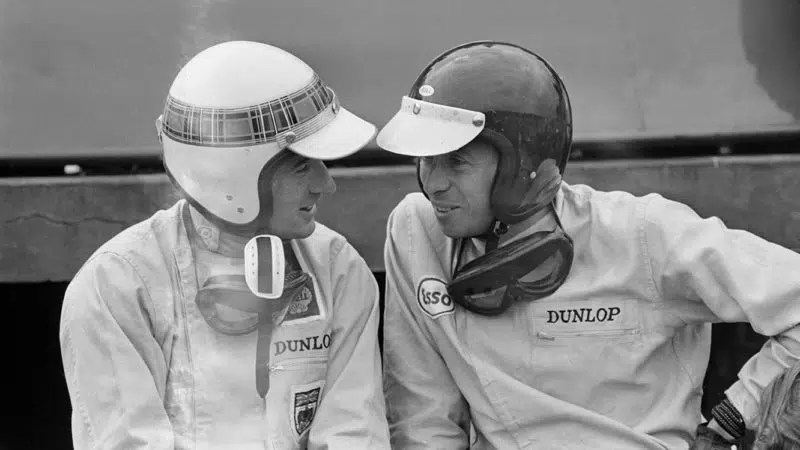
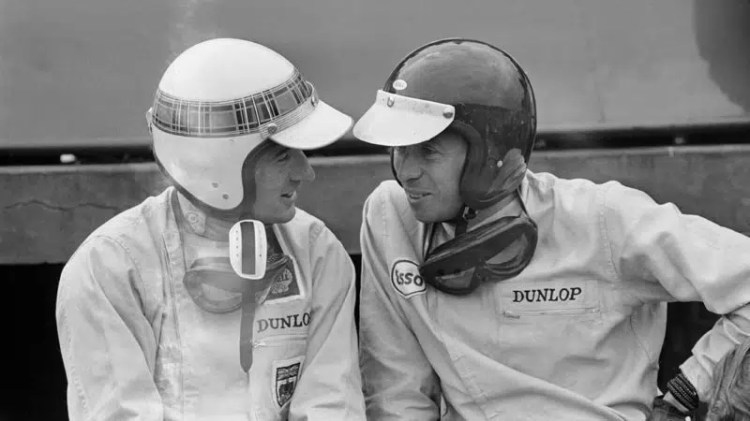
In the wake of Jim Clarke’s death, the F1 community was devastated – it had lost its talisman, its best driver and more importantly, a friend. Colin Chapman said he lost his best friend that day – many F1 drivers were in his close circle, including his compatriot Jackie Stewart. In a tragic turn of fate on that afternoon in Germany, F1 lost its talisman, but his successor was waiting in the wings.
The Flying Scotsman
Stewart had been following in Clarke’s footsteps throughout his junior career and reached F1 in 1964 as Clarke was taking over. He had some success during his early years, winning 2 races in his first 2 years in F1. However, things changed in 1968. Stewart had been driving for Ken Tyrell’s racing outfit in the lower formula but switched to Owen Racing to gain an F1 seat. He would reunite with Tyrell, joining the Ken Tyrell-run Matra team. This partnership would turn out to be one of the most successful in F1 history. He would win his first title in 1969 for Matra International and made the switch to the full Tyrell team in 1970 for its inaugural season. He would win two championships in the French Racing Blue of The Elf Tyrell team in 1971 and 1973. He retired immediately before taking part in his 100th F1 race after the death of his teammate and friend Francois Cevert in practise at Watkins Glen. This was the last straw in a career where he lost too many friends to sub-standard safety in the sport. These losses, including his great friend Jim, would motivate Stewart to campaign for improved safety during and after his career, changing the way the sport is run forever. He retired with the record for most wins at 27.
“I would have been a much more popular World Champion if I had always said what people wanted to hear. I might have been dead, but definitely more popular”
Sir Jackie Stewart
 The Perfect Formula