Monaco Grand Prix Driver Ratings

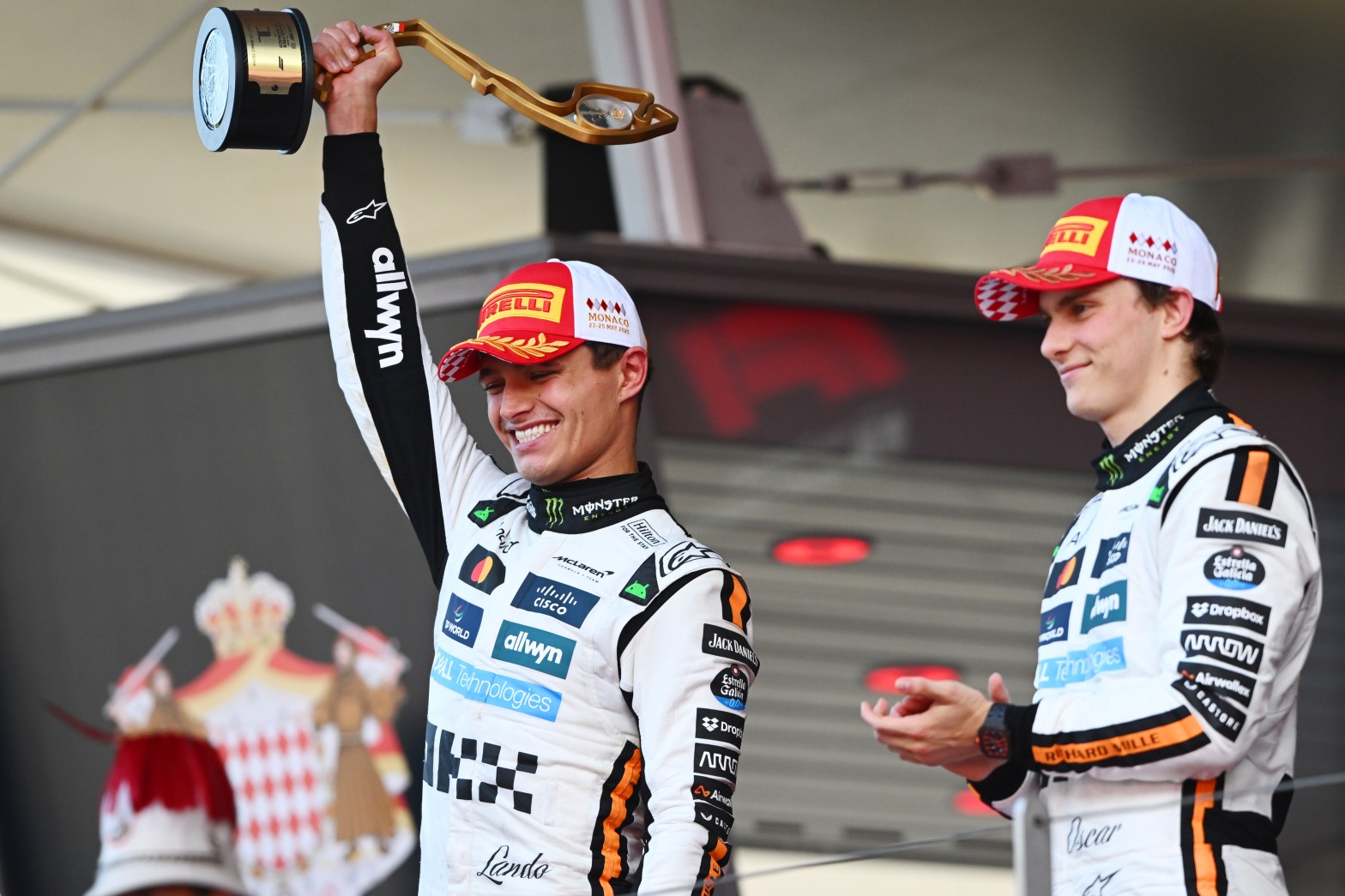
MONTE-CARLO, MONACO - MAY 25: Race winner Lando Norris of Great Britain and McLaren and Third placed Oscar Piastri of Australia and McLaren celebrate on the podium during the F1 Grand Prix of Monaco at Circuit de Monaco on May 25, 2025 in Monte-Carlo, Monaco. (Photo by Rudy Carezzevoli/Getty Images) *** BESTPIX ***

The Monaco harbour was basked in its usual summer glow as Lando Norris won his maiden Monaco Grand Prix on Sunday, but the action didn’t reflect the glorious setting. Formula 1 tried a different tactic to spice up the racing at Monaco, however, their mandatory two-stop rule only seemed to highlight that Formula 1 has outgrown Monaco and there isn’t anything they can do to fix their biggest issue. You just can’t overtake.

I liked the idea of F1 trying something different at Monaco as the traditional one-stop, track-position-is-king, procession has gotten very old. It came to a head in 2024 as a first lap red flag gave everyone the chance to conduct their mandatory tyre swap, all going onto the hards and going to the end. Ive watched pretty much every race since 1970 and this was the worst boring, by far.

Unfortunately, despite the chaos that the mandatory two-stop brought, it wasn’t the right chaos and didn’t fix the age-old problem for Monaco. The top 10 largely finished where they started, with the only actual overtake happening on track, on the last lap, as Stroll went around the outside of Hulkenberg.

Best to just get on with the ratings as we don’t need to review pit stops and Trulli trains (sorry Jarno)

Lando Norris

Lando Norris was the star of the weekend, securing a brilliant pole position and executing a calm, controlled race to take the win. His only misstep was a double lock-up into Turn 1, but he got away with it. Norris held off Charles Leclerc under pressure, showcasing his maturity and skill on the most demanding circuit of the season.
Rating: 8.8

Charles Leclerc

Charles Leclerc was in the hunt for victory all afternoon, staying within four to five seconds of Norris but unable to find a way past on Monaco’s tight streets. A strong qualifying performance put him on the front row, and Ferrari looked quicker than expected. A solid drive, but just shy of the top step.
Rating: 8.7

Oscar Piastri

Oscar Piastri claimed his second podium of the season with a solid third-place finish. He was a couple of tenths off Norris all weekend and looked a bit scruffy at times, which is uncharacteristic for the Australian. Still, he continues his impressive run of scoring points in every race this season.
Rating: 7.9

Max Verstappen

Max Verstappen and Red Bull were a couple of tenths off the pace all weekend, which was expected given the circuit’s characteristics. Verstappen hung around in fourth, hoping for a red flag or safety car that never came. A relatively quiet weekend by his high standards.
Rating: 7.5

Lewis Hamilton

Lewis Hamilton was one of the few drivers to make progress on Sunday. Starting seventh after a qualifying penalty, he used the overcut to jump Esteban Ocon and Isaac Hadjar in the pits. However, he was stuck in no man’s land for much of the race, too quick for the cars behind but too far back to challenge the leaders.
Rating: 7.7

Isaac Hadjar

Isaac Hadjar had another strong weekend, qualifying sixth and starting fifth after Hamilton’s penalty. His team used strategy effectively, with Liam Lawson holding up the field to help Hadjar build a gap. A well-executed race earned him a solid sixth place.
Rating: 8.1

Esteban Ocon

Esteban Ocon delivered an understated but impressive performance. He qualified seventh and finished seventh, rarely seen during the race but consistently quick. A great weekend for Ocon that went somewhat unnoticed.
Rating: 7.9

Liam Lawson

Liam Lawson played the team game early on, sacrificing his strategy to help Hadjar. He qualified ninth and finished eighth, earning solid points. A welcome result for Lawson, who showed both speed and teamwork.
Rating: 7.7

Alex Albon

Alex Albon qualified ninth and finished ninth, playing the team game with Williams. He was cheekily overtaken by George Russell when he deliberately skipped the Novelle chicane, and would receive a penalty. Albon’s two points were well-earned in a tricky race.
Rating: 7.0

Carlos Sainz

Carlos Sainz had a similar race to Albon, qualifying eleventh and finishing tenth. He initially let Albon ahead to play the team game, then swapped back to secure a point. A solid drive, but missing Q3 limited his potential.
Rating: 7.3

George Russell

George Russell had a disappointing weekend, retiring in qualifying due to an electrical issue and starting fourteenth. He made up positions to finish eleventh but was stuck in the Monaco train for most of the race. Mercedes missed a trick by not splitting strategies and he was rightly penalised for intentionally skipping the chicane to pass Albon in hope of improving his position.
Rating: 6.2

Ollie Bearman

Ollie Bearman qualified last and finished twelfth, stuck in the Monaco train for the entire race. A tough weekend with little opportunity to make progress, but took advantage of the Lap 1 virtual safety car to gain a pit stop over most of the midfield.
Rating: 6.0

Franco Colapinto

Franco Colapinto pitted early to gain track position but was also stuck in the Monaco train. He finished thirteenth in a race where overtaking was nearly impossible.
Rating: 6.0

Gabriel Bortoleto

Gabriel Bortoleto recovered well after a first-lap crash, pitting under the virtual safety car to gain time. He finished fourteenth, ahead of his teammate, in a race where his crash ironically helped his strategy.
Rating: 6.5

Lance Stroll

Lance Stroll made one of the few overtakes of the race, passing Hulkenberg around the outside at the Nouvelle Chicane on the final lap. A small but impressive moment in an otherwise uneventful race.
Rating: 6.8

Nico Hulkenberg

Nico Hulkenberg was unlucky with strategy, pitting early and dropping back to fifteenth. A decent qualifying session was the highlight of his weekend.
Rating: 7.2

Yuki Tsunoda

Yuki Tsunoda was involved in an early crash with Pierre Gasly, which left him with significant car damage. He finished seventeenth, stuck in traffic and unable to make progress.
Rating: 5.5

Kimi Antonelli

Kimi Antonelli crashed in qualifying and started near the back. He was stuck in the Monaco train all race, finishing eighteenth in a disappointing weekend for Mercedes.
Rating: 5.2

Fernando Alonso

Fernando Alonso’s unlucky streak continued, retiring from sixth place due to an engine failure. He was on course for his first points of the season before the issue struck.
Rating: 7.7

Pierre Gasly

Pierre Gasly’s weekend was ruined by a brake issue that caused him to crash into Tsunoda on the first lap. He retired early, making it impossible to grade his performance fairly.
Rating: 5.2

Overview

The Monaco Grand Prix once again highlighted the challenges of overtaking on the tight, twisting streets of the principality. While the mandatory two-stop strategy added some intrigue, it also emphasized the need for rule tweaks to make the race more exciting. Despite its flaws, Monaco remains the jewel in Formula 1’s crown, and its place on the calendar is secure. Next up, the triple header concludes in Barcelona, where McLaren and Verstappen are expected to battle it out on a circuit with medium to high-speed corners. See you there!
The Horse Starts Pushing the Cart

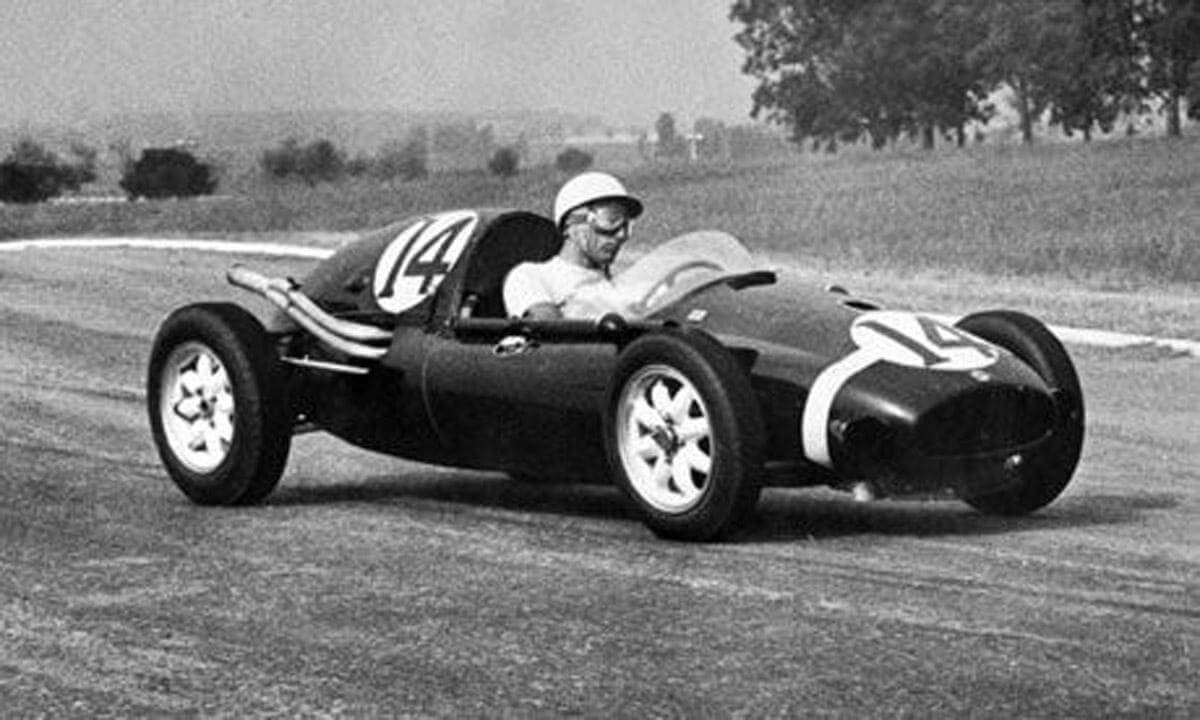
For as long as cars had been racing each other, be it up hills, around airfields or streets, their engines had been in front of the driver. That was just how it worked. Enzo Ferrari summed it up beautifully when he said “The horse shouldn’t push the cart with its nose, it pulls it” but this all changed in 1958. Formula 1 is all about innovation and before long someone had come up with a better solution. This solution would change not just F1, but all of motorsport.

This great innovation wasn’t thought up by one of the big boys in a factory but by father-son duo Charles and John Cooper. They had started making racing cars from their garage in Surbiton, Surrey in 1946, entered F1 in 1950 at the Monaco Grand Prix and by the mid 1950s, they had built up a considerable reputation for building fast cars.

So when Jack Brabham turned up to the 1957 Monaco Grand Prix and finished 6th in a Cooper T43 Climax with the engine positioned behind him, the F1 community took note. However, it wasn’t until the first two races of 1958 when they would realise that they had a revolution on their hands. Sterling Moss would win the Argentinian Grand Prix in a privately run rear-engined Cooper T43 on a controversial no strategy but when Maurice Trintignant won the next race in Monaco at a canter in the exact same car, the cat was out of the bag and F1 would never be the same.

What the Coopers realised was rear-engined cars pushed the majority of weight to the middle so the cars were less susceptible to spinning, easier to control and more effective at transferring traction into the road. They found time by giving the driver more confidence to push, and rewarded them with more grip when they did.

Despite Enzo Ferrari’s stubbornness, over the next couple years the rest of the grid would transition to rear-engined cars and the final victory for a front-engined car would come at the Italian Grand Prix of 1959 at Monza. It was won by Ferrari, but not by coincidence, after the race organisers changed the track layout to include the famous banking, the bumpy surface suiting the rear-engined car much more favourably.

Jack Brabham would go on to win the Driver’s Championship in 1959 and 1960 for Cooper, becoming the first rear-engined Champion. Since then, every other driver and constructor to win the F1 championship has won with the horse pushing them by its nose.

P.S. – An extra fun fact to leave you with – John Cooper is the naming inspiration for one of the most famous cars in history – The Mini Cooper, which he helped to conceive.

F1 Driver POWER Rankings – Monaco Edition

Welcome to the fifth edition of my F1 driver POWER rankings list. I hope you enjoyed my previous edition after the Spanish Grand Prix but if you didn’t get around to reading it and don’t want any spoilers, you can find it here.

This years running of the Monaco Grand Prix helped prove my point in my Why is Monaco So Special? post. 95% of the excitement happened before the five lights went out on Sunday. It was looking like a fairytale was on the cards with Charles Leclerc, rather fortuitously, sticking it on pole after crashing during the final runs of qualifying while on provisional pole. This stopped Verstappen and Bottas from completing very fast laps which the Ferrari’s would have done well to beat. This Ferrari pace was surprise of the weekend and it added extra spice to the competition, with Hamilton losing out because of it. It was the first time in a long time that three teams were genuinely in the fight for pole. Leclerc was unable to take the start due to a left driveshaft failure on his reconnaissance lap which left Verstappen to lead the field into Turn 1 once he had fended off Bottas. He would go quite unopposed to the chequered flag in quite a dull affair with no real on track action post Lap 1. Doesn’t mean that weren’t opportunities to shine with an old champion showing his speed once again. Lets get into it.

After Monaco Grand Prix (5 of 23)

1. Max Verstappen (+1)

The first change in ranking for the ‘Big Two’ this season sees Max jump Hamilton but I can’t deny the significance of the weekend in the early running of this championship. Hamilton was looking like getting away in the drivers championship coming into the weekend with a 3-1 lead in the win stakes. We exit the weekend, however, with Max taking the lead in the championship for the first time in his career and Red Bull leading the Constructors. He was on a super quick lap in Q3 before it was halted early by Leclerc’s crash and I think he would have taken pole. With Leclerc cleared out of the way before the start a Max win felt inevitable, especially once Bottas retired. This was his first victory around the streets of Monte Carlo and this coupled with a tricky weekend for Hamilton puts Verstappen in a great position going to Baku.

2. Lewis Hamilton (-1)

Hamilton was never on the leading pace all weekend, seemingly about 0.2/0.3 seconds back consistently. It came down to not being able to warm the tyres enough, which is vital to give the driver confidence around the ultimate confidence track. We don’t know where he could have got without Leclerc’s crash but he qualified a disappointing seventh on a track where it is almost impossible to overtake. He was staring at the back of Pierre Gasly’s Alpha Tauri for pretty much 79 Laps and lost out to Perez and Vettel who both performed very effective overcuts. Lewis sounded very frustrated on the radio but he has learnt to control his emotions and move on from weekend’s like this so I am expecting the fight to commence in Baku which has been a happy hunting ground for Mercedes in recent years.

3. Lando Norris (+1)

A return to the podium in Monaco means a return to the podium of this list for Norris. He got himself at the sharp end on Saturday, qualifying fifth, and was rewarded for his efforts when Leclerc and Bottas retired ahead of him to take McLaren’s first podium at Monaco since they last had Mercedes engines. He had a quiet race but his confidence and pace on Saturday got him this result. A good way to make sure everyone forgets all about Spain.

4. Charles Leclerc (-1)

Charles drops because you have to complete the weekend. He was driving beautifully at his home Grand Prix, the first Monegasque driver to take pole at his home race since 1931, even though it was slightly fortuitous and by his own doing when he crashed in Q3 to secure it. I don’t accept the ‘Monaco curse’ excuse for Leclerc this time, it was his mistake that cost him victory on Sunday. A broken left driveshaft meant that he couldn’t take the start as Ferrari only identified the issue on the way to the grid which didn’t give enough time to fix it. Lots of potential but no end result this time around at home for Charles.

5. Carlos Sainz (+4)

Carlos was the more impressive Ferrari driver around Monaco and I think he would have beaten Leclerc in qualifying had it not been for his teammate’s crash. He was disappointed with fourth on the grid when pole was a genuine possibility and he kept pace with Bottas easily during the race, backing up his claim. Sainz, like Norris, benefitted from retirements ahead to take his first Monaco and Ferrari podium with second. A fantastic weekend for the Spaniard and what a way to endear yourself to the Tifosi. A massive weekend for Sainz and the biggest move yet on this list.

6. Pierre Gasly (+2)

Another result which means you have to stand up and take notice of Pierre Gasly. He qualified and finished ahead of a works Mercedes in Monaco as he started and finished in sixth. On a track which rewards driver ability and confidence, Gasly shone brightly. He did well in the race to guard against the Hamilton undercut and then used his car width to keep him behind. He did lose two places through strategy but he can’t be blamed for that. Surely another chance at a big team must be in his future.

7. Sergio Perez (-+)

Sergio’s race pace once again saved his blushes at Monaco but he still hasn’t been able to put a complete weekend together. He can be excused for being slower than Max in qualifying around Monaco if he isn’t fully in tune with the car and Perez was hampered by Leclerc’s crash to start ninth. His pace in clear air once people in front had pitted was equal to Verstappen out front and this meant he jumped up to fourth after the pit stops. A wonderfully performed over cut. Perez said that it would take him five races to get up to speed in this Red Bull and those five have now passed. It is time he joined the big two in the fight.

8. Lance Stroll (-3)

This was the first weekend all season where Stroll was beaten by his teammate in both Quali and the race. He missed out on Q3 to line up thirteenth but progressed further than anyone in the race to finish eighth. Unfortunately for Lance, others around him on this list had superb weekends. Some good points and good strategy are the positives from Monaco for the Canadian.

9. Esteban Ocon (+1)

Ocon is becoming the main guy at Alpine. He capitalised on an out-of-sorts Alonso to make himself look good around the streets of Monte Carlo. While he missed out on Q3 by six one hundredths of a second to line up eleventh, he moved up to ninth at the flag after a great start and some good strategic calls from the pit lane. It has been reported that Alpine have been so impressed they are already negotiating a contract extension for the Frenchman, deciding against trying to sign another young French driver.

10. Daniel Ricciardo (-4)

Spain feels a long time ago all of a sudden for Daniel Ricciardo. He was slow all weekend around Monaco and he wasn’t really sure why, which isn’t encouraging. His qualifying position of twelfth was his highest finish of any session during the weekend, equaled by his finishing position on Sunday. Once locked into grid spot, he was stuck in the midfield and his destiny sealed. I think his lack of pace around Monaco really highlights the lack of chemistry between car and driver in this package at the moment. Next stop is another tricky street circuit that he has previously won but one that should be able to hide his blushes better because of that big ol’ straight.

11. Sebastian Vettel (+3)

He’s back baby, well at least for this weekend he was. Sebastian showed some of that Vettel fighting spirit when it counted on Sunday to jump Gasly and Hamilton in the pit stops using the overcut. He made up four seconds in two laps to make it possible and then held off Gasly up the hill to Casino Square to show a side that’s been missing the last 12 months. Vettel was the leading Aston Martin in every session and made it into Q3 for the first time in 10 months with eighth on the grid. That aforementioned fighting spirit rewarded him with a fifth place finish and it was nice to hear the joy in his post race radio celebration once again.

12. George Russell (-+)

A quiet weekend for George Russell in Monaco but another one where he leads his team to Q2 at the expense of a big name. He would be annoyed not to move forward more in the race with some retirements but the Williams is still a step away in direct combat with other cars not with Haas branding.

13. Kimi Raikkonen (-+)

Kimi was beaten fair and square by Giovinazzi in Monaco. Not much to say for Kimi this weekend as I feel the result was comfortably within Alfa Romeo’s window. He qualified fourteenth, used the stronger overcut to get up to eleventh but was a long way off his teammate and only caught him because of a slow Ocon in front.

14. Fernando Alonso (-3)

Fernando was another previous Monaco winner to be mysteriously slow. He was knocked out in Q1 to start seventeenth and was nowhere near the points on Sunday. He complained of not being able to get the tyres into the right temperature window which would explain it but is it another example of the two year hiatus holding him back at the start to this season?

15. Valtteri Bottas (-+)

Is Bottas this generation’s Rubens Barrichello? It feels like he has inherited his bad luck. Valtteri looked the quicker of the two Mercedes drivers during qualifying and the race in Monaco and was on course to take some good points out of his teammate. He was in the fight for pole but also had to halt a much faster lap in Q3 due to Leclerc’s incident and had to settle for third. This turned into second with Leclerc’s DNS. He had one chance at the start to get into the lead but Max shut that door quickly. A podium was in the bag, however, a faulty wheel nut getting stuck in place at his pit stop meant it was impossible to change tyres and forced him to retire from second. It feels like the universe doesn’t want Bottas to interfere in the title fight, just like it did for Barrichello all those years ago.

16. Antonio Giovinazzi (+2)

Giovinazzi is starting to change my mind about him, he is stringing some nice weekends together in this Alfa Romeo and now looks like the leading driver in that team. He got himself into Q3 as one of seven different teams represented in the final part of qualifying and started the race tenth. He showed off his race craft on the first lap with an opportunistic move around the outside at Mirabeau on Ocon. He was rewarded with a championship point for his efforts.

17. Mick Schumacher (-1)

Mick found out how dangerous the Monaco barriers can be in FP3 on Saturday morning with a heavy crash at Casino Square, losing the back end and destroying much of the left hand side of the car. He would miss qualifying and line up last for the race. He got past his teammate at the Lowes hairpin on Lap 1 but lost the place later on to be beaten to the flag by Mazipin for the first time in 2021.

18. Yuki Tsunoda (-1)

Tsunoda had never driven around Monaco before this weekend as COVID interrupted his only season in F2 with the race being cancelled. This really puts into context how raw of a talent Yuki is. It showed as it took him a while to warm up and he was never relevant on track during the weekend. This is just another notch in his F1 education with more data logged.

19. Nicolas Latifi (-+)

Don’t know what else to say for Latifi apart from he started eighteenth and finished fifteenth. He was able to match his teammate’s race pace which is nice for him.

20. Nikita Mazipin (-+)

Signs of life from Mazipin as he looked as quick as his teammate all weekend and finished ahead of him on merit on Sunday to take his first teammate clean sweep of the season. You would have got good odds for Mazipin not to be the Haas driver in the barriers this weekend. Onwards and upwards.

Why Is Monaco So Special?

Don’t be fooled, the title isn’t an early indication of a glorifying 1000 words about the greatness of the Monaco Grand Prix around the streets of Monte Carlo. It is a genuine question. I just don’t know how I feel about it and that is the purpose of this post – to try to figure it out – and also to give myself a bit of a time based test of my own. This is probably going to end up being an argument with myself but lets see how it goes.

Monaco in its current configuration

If I’m being perfectly honest I have never cared for the Monaco Grand Prix. The phrase brings up feelings of boredom and frustration from deep within as the race would never live up to expectations as the ‘Jewel in the Crown’ of the F1 calendar and one third of the famous Triple Crown. It would be built up to a crescendo on Sunday with a packed grid full of celebrities and glamorous people bringing the worlds attention to the principality. However, the crescendo would fizzle out as no-one would be able to overtake around the tight and twisty streets. It would also be the race which, if any, people around me would attempt to watch. This would lead to the inevitable remarks that it’s just “cars driving around in circles” and “nothing happens” which is maybe where all my annoyance with this event comes from. I think that is where I am going with this though, I don’t think it is a good ambassador for the sport to the wider world, which I imagine is only looking for an almighty shunt at the start before quickly switching over. I wish tracks like Spa, Suzuka, Montreal or Hockenheim had the global reach or appeal of Monaco. Then they would see the real Formula 1.

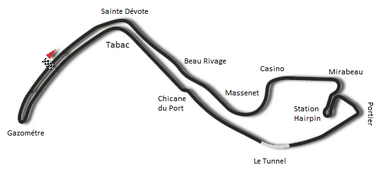
Monaco configuration 1929-1972

Before writing this I also thought Ferrari dominance would factor into my dislike of Monaco but in my viewing years they have only won three times, two of those with Schumacher at the turn of the 21st century. Peculiarly, McLaren have been quite successful at Monaco in my F1 life, winning five times since 2000, which is joint best with Mercedes (and Red Bull now after Max’s win). So you would assume I would feel more warmly towards it. The problem I have is that the result feels predictable once the grid has been set on Saturday. Since 2000, 12 of the 19 races have been won from pole and no one has won it from outside the top 3. Unfortunately for me in these arguments with my friends, this does back up their view that it’s “just cars driving around in circles”. Monaco ranks last in average overtakes for tracks that have hosted at least 10 races over the last 20 years – with 12 (I took a look at the data). To put it into context, Shanghai is the leader with a massive 52 and the next track on the list above Monaco, which is still on the calendar, is Barcelona at 20. While I do love a strategic battle of the minds, overtaking and close racing is what I want to watch and Monaco just does not provide that, especially now the cars are wider than ever and the streets of Monaco are as narrow as they were in the 1920s.

In short, I don’t like that it is the most hyped race weekend on the calendar but rarely lives up to its billing. A bit like Champions League finals between Italian teams at Old Trafford – a lot of old nothing.

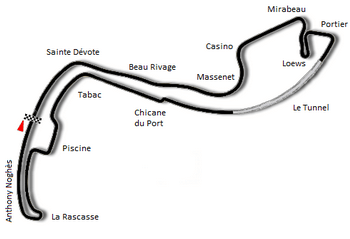
Monaco configuration 1973 – 1975

Now to the other side of the argument; the reasons I am so torn in my feelings. What it has on its side is a combination of history and prestige. It is the original street circuit and one that all the drivers want to win above all else. This is because, without doubt, Monaco is the ultimate test, both of driver and machine. The claustrophobic barriers lining the track mean a mistake will most likely end your race, and at the very least derail it massively without much chance to recover due to the difficulty to overtake. For the drivers it is as much a mental challenge as it is a physical one, their brains having to process so much information for 90 minutes just to finish the race. There is no room for a slip in concentration, even the straights at Monaco aren’t straight. The corners relentlessly keep coming.

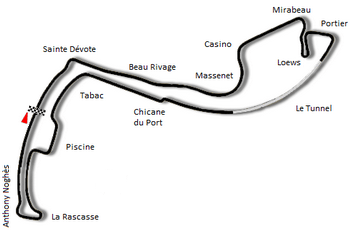
Monaco configuration 1976 – 1985

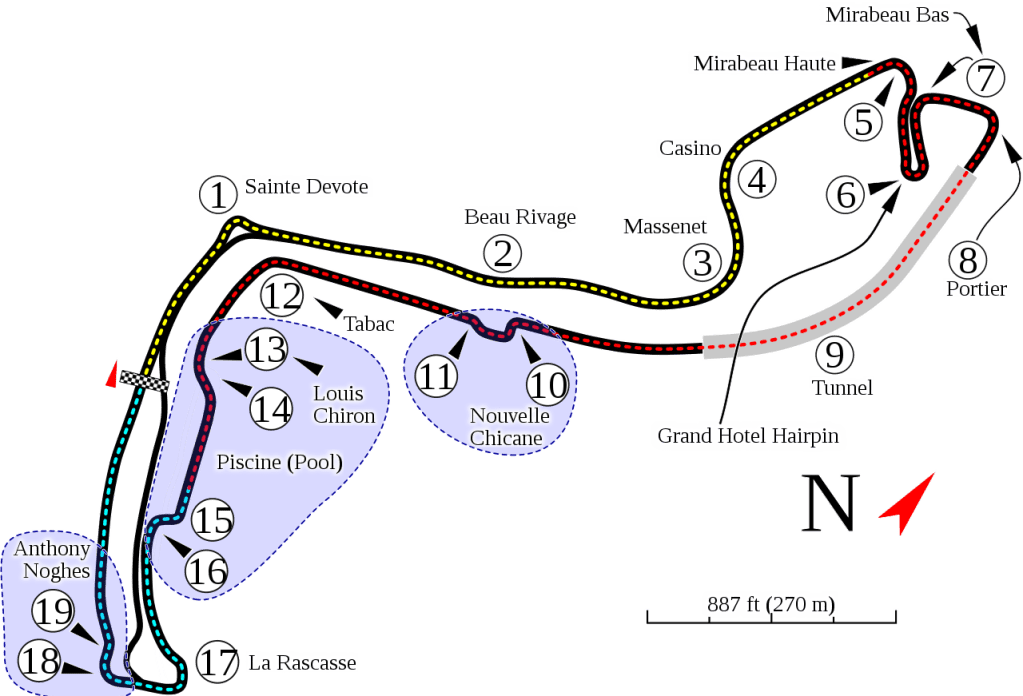
The legacy of the Monaco Grand Prix is it’s biggest attraction. The race pre-dates Formula 1 itself, with its first iteration being in 1929 and was organised by driver Anthony Noghes, who the last corner is named after, under the guidance of Prince Louis II. It has been a permanent fixture in motorsport and the F1 calendar ever since, with only World War II & COVID-19 halting festivities. As you will see by the pictures of the track dispersed throughout this article, the layout has hardly changed in its history, with only a few chicanes put in, like at the Swimming Pool, and some corners have been extended, like at Rascasse. This means that while the cars have changed, the challenge hasn’t. It links the eras of Formula 1 unlike any other track. The experiences of F1 and Monaco greats like Graham Hill and Ayrton Senna can be replicated by today’s drivers. That is where the prestige of Monaco comes from, once a driver wins the race they go into a very small fraternity of greats who have conquered this unique challenge. It seems like it is a right of passage for any future World Champion to win at Monaco as every multiple World Champion in history has done it at least once. This is why I would never want it to leave the F1 calendar, despite my objections. It separates legends from pretenders.

The events of Qualifying for the 2021 Grand Prix have, amusingly, challenged my feelings about one of my own arguments above. It started off as a negative thought – “the most important day at Monaco is Saturday” meaning that because overtaking is almost impossible, the place you start is going to be the place you finish. (See paragraph 3) However, this thought evolved to a positive “it creates a different dynamic to the weekend and gives more importance to a session that rarely disappoints – Qualifying”. As like 16 years ago, a Ferrari crashed on the final run in qualifying while on provisional pole to thwart cars on better laps behind. When Michael Schumacher did it, it was obviously deliberate and he was punished accordingly. This Leclerc crash seemed different, but the rumour mill starts milling anyway. A paddock abuzz with excitement like the melodrama that Formula 1 is and it happening at Monaco is a big reason why some people think he did it deliberately. It’s what Monaco does to drivers. The pursuit of the ultimate prize. However, in typical Monaco style, the race was a procession and I had forgotten about the excitement of Saturday by Lap 2.

I could keep going on and on about the pros and cons of Monaco, trapping myself in a large web of emotions but I think it best to end my indecisive ramblings here. I haven’t succeeded. I laid both sides out there but I am no closer to deciding how I Trulli feel about the Monaco Grand Prix (see what I did there!?). It has me loving it one day, loathing it the next. Maybe that is it’s charm – damn I’m confused. Anyway, it doesn’t matter, this exercise was just something ‘to do’. Also, for those of you who were wondering, I did not stick to my time limit.

JL

P.S. I can’t end this article without giving the racing around Monaco some love, because there have been some great moments and races. Here are a few of my favourites:

Senna vs Mansell 1992

An example of exciting racing where no overtakes were made. Nigel Mansell had been dominating the 1992 Monaco Grand Prix in the revolutionary active suspension Williams but was forced to make a late stop but came out behind Ayrton Senna on much older tyres. Mansell would close very quickly and swarm around the McLaren but was unable to pass. They finished 0.2 seconds apart and the body language of the cars represented their drivers characters; Mansell’s Williams like a British Bulldog badgering and hounding Senna’s cool, calm and collected style. It seemed like Senna never looked back to see where the Englishman was but placed his car perfectly to win the race.

1996 Chaos

A race which started in the wet and ended in the dry was one that no one seemed destined to win. Damon Hill was running away with it after Schumacher crashed on Lap 1 but an engine failure through the tunnel ended his run to victory. Jean Alesi retired from the lead when his Bennetton broke down as well leaving Frenchman Olivier Panis in the Ligier to come home victorious. It wasn’t plain sailing behind either as only 4 drivers were classified at the end. This is a prime example of the unpredictably that Monaco can cause, especially in tricky conditions. Classic case of to finish first, first you have to finish.

Hamilton emulates Senna – 2008

This race has a special place in my heart as it was the first of two fantastic wet weather drives that lead Hamilton to his first world title in 2008. He started third but beat Raikkonen off the line to follow leader Felipe Massa into Sainte Devote. He would make an error on Lap 7 and touch the barriers, causing a puncture. McLaren made a brilliant tactical decision to fill his car with fuel and hope to get to the dry conditions without pitting again. Hamilton would hold up his side of the bargain with a faultlessly fast and consistent drive from there on in to take victory while more chaos ensued behind.