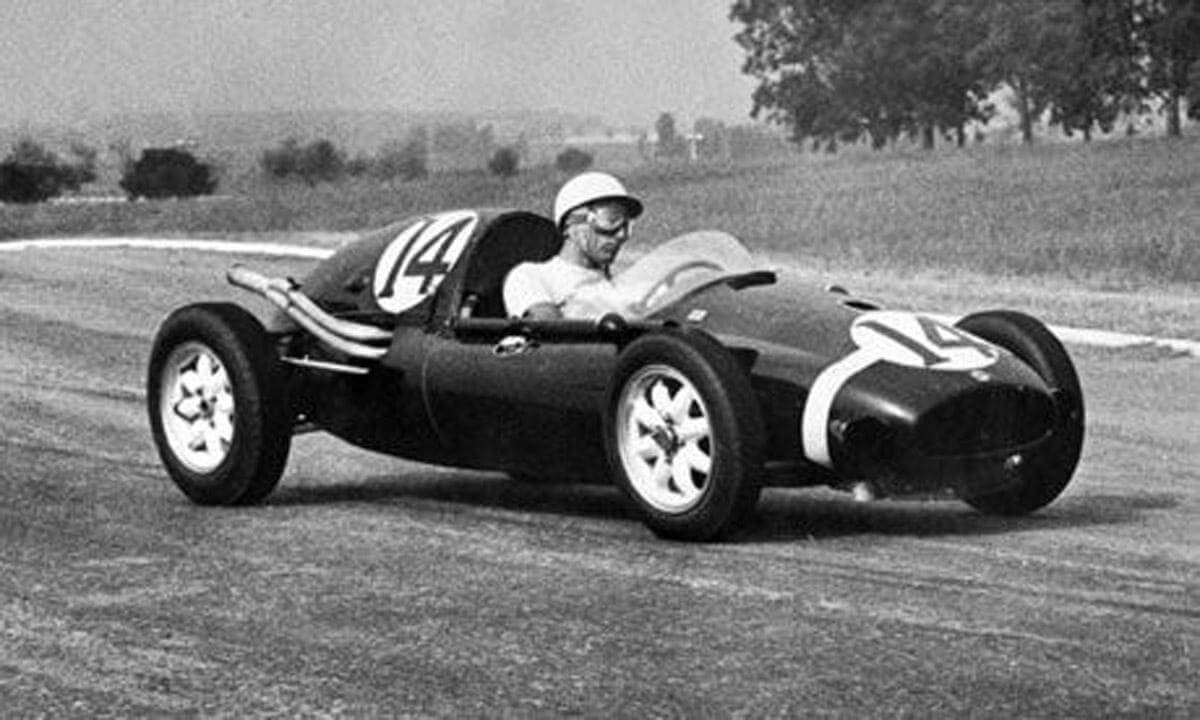
For as long as cars had been racing each other, be it up hills, around airfields or streets, their engines had been in front of the driver. That was just how it worked. Enzo Ferrari summed it up beautifully when he said “The horse shouldn’t push the cart with its nose, it pulls it” but this all changed in 1958. Formula 1 is all about innovation and before long someone had come up with a better solution. This solution would change not just F1, but all of motorsport.
This great innovation wasn’t thought up by one of the big boys in a factory but by father-son duo Charles and John Cooper. They had started making racing cars from their garage in Surbiton, Surrey in 1946, entered F1 in 1950 at the Monaco Grand Prix and by the mid 1950s, they had built up a considerable reputation for building fast cars.
So when Jack Brabham turned up to the 1957 Monaco Grand Prix and finished 6th in a Cooper T43 Climax with the engine positioned behind him, the F1 community took note. However, it wasn’t until the first two races of 1958 when they would realise that they had a revolution on their hands. Sterling Moss would win the Argentinian Grand Prix in a privately run rear-engined Cooper T43 on a controversial no strategy but when Maurice Trintignant won the next race in Monaco at a canter in the exact same car, the cat was out of the bag and F1 would never be the same.
What the Coopers realised was rear-engined cars pushed the majority of weight to the middle so the cars were less susceptible to spinning, easier to control and more effective at transferring traction into the road. They found time by giving the driver more confidence to push, and rewarded them with more grip when they did.
Despite Enzo Ferrari’s stubbornness, over the next couple years the rest of the grid would transition to rear-engined cars and the final victory for a front-engined car would come at the Italian Grand Prix of 1959 at Monza. It was won by Ferrari, but not by coincidence, after the race organisers changed the track layout to include the famous banking, the bumpy surface suiting the rear-engined car much more favourably.
Jack Brabham would go on to win the Driver’s Championship in 1959 and 1960 for Cooper, becoming the first rear-engined Champion. Since then, every other driver and constructor to win the F1 championship has won with the horse pushing them by its nose.
P.S. – An extra fun fact to leave you with – John Cooper is the naming inspiration for one of the most famous cars in history – The Mini Cooper, which he helped to conceive.
 The Perfect Formula
I read to the end this time. Great stuff!
LikeLike